Pressure Shrinks Thinking
Why decision quality degrades before performance does

TL;DR
Pressure narrows perception before it shows up in outcomes.
Decision quality degrades upstream, long before performance drops.
The advantage under pressure isn’t speed, it’s preserving cognitive range.
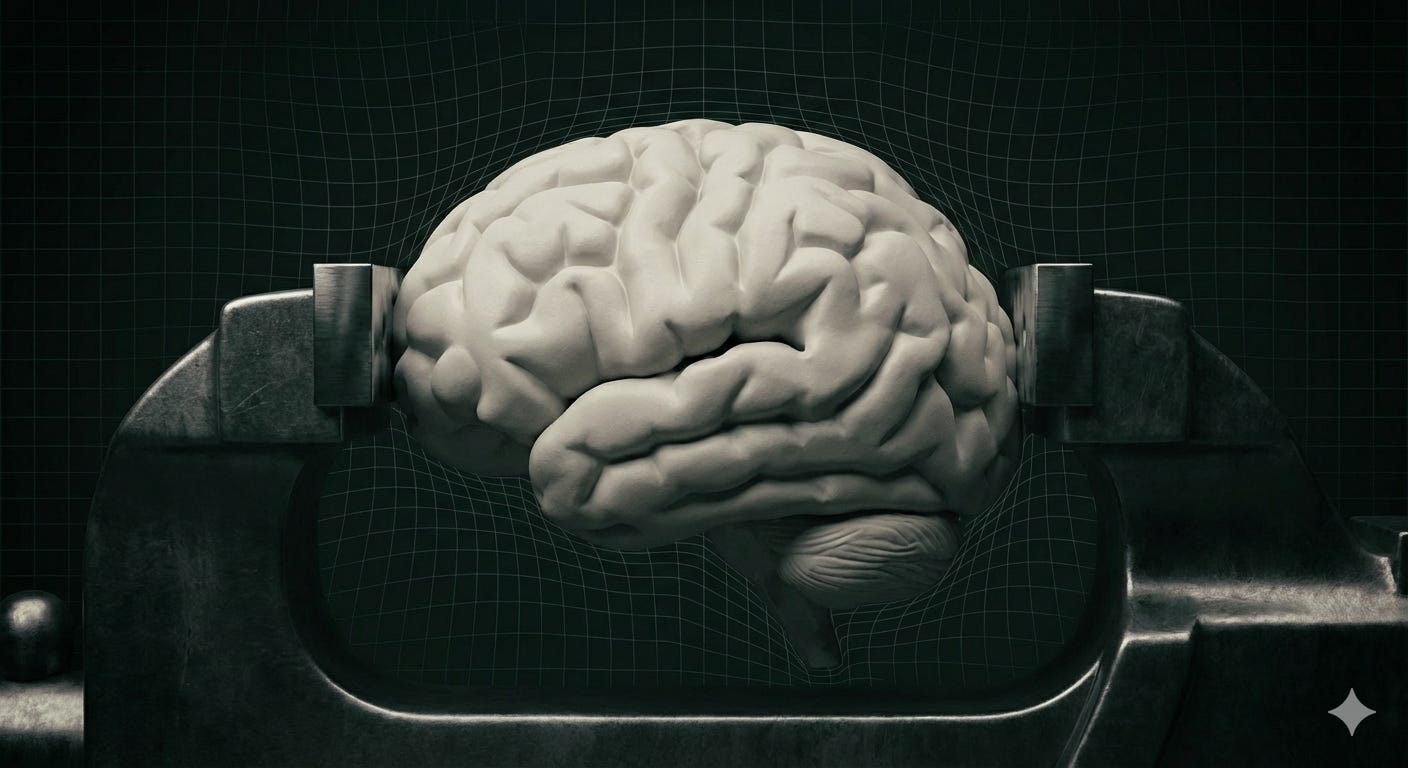
One of the easiest mistakes leaders make under pressure is looking for failure in results rather than in perception.
By the time performance starts to slip, the damage is usually already done. Not in effort. Not in intent. But in how the situation was framed, what information was attended to, and which options quietly fell out of view.
Pressure doesn’t make people irrational.
It makes them narrower.
That narrowing tends to go unnoticed because decisions made under pressure often feel clearer, not messier. Confidence rises. Ambiguity seems to fall away. The call feels obvious.
That’s usually the problem.
What’s happening cognitively
This isn’t a metaphorical claim about “stress” or “overwhelm.”
It’s a well-described neurobiological shift.
Work by Amy Arnsten and others shows that even moderate stress impairs prefrontal cortex functioning, particularly working memory and cognitive flexibility. These are the very capacities required to hold multiple variables in mind, consider trade-offs, and update assumptions as new information appears.
As stress chemistry increases, the brain becomes more reliant on dominant patterns and previously reinforced responses. Thinking doesn’t stop, but it becomes less exploratory and more confirmatory.
In practical terms, people don’t lose intelligence under pressure.
They lose range.
And because range collapses before logic does, the decision can still sound coherent, even persuasive, while being fundamentally incomplete.
How this shows up in real environments
I see the same pattern repeat across very different settings.
In senior leadership teams under sustained pressure, discussion often tightens. Debate becomes more positional. Speed starts to signal competence, while hesitation is quietly read as risk or lack of conviction. Dissent is still verbally invited, but socially expensive.
Everyone in the room is capable.
Everyone is engaged.
Yet fewer options are genuinely considered.
A similar shift shows up in elite sport. Late in competition, athletes often accelerate decision-making at precisely the moment when the environment demands broader awareness. Attention locks onto the most salient cue. Peripheral information drops out. Execution speeds up, but reading of the situation degrades.
What’s striking is that, in both cases, the individual usually feels decisive rather than compromised.
Research on stress and decision making reflects this. Under pressure, perceived certainty often increases, particularly for complex or ambiguous problems, even as accuracy declines. Confidence and range move in opposite directions.
Why more information isn’t the fix leaders expect
When leaders sense something is off, the instinctive response is often to ask for more data.
That move makes sense on the surface, but it rarely addresses the real constraint.
More information inside a narrowed frame doesn’t expand thinking. It reinforces it. The same assumptions guide what is gathered, what is weighted, and what is ignored.
The issue isn’t lack of analysis.
It’s how the problem has been bounded.
What helps more is a metacognitive shift. Changing the frame before adding depth. Making assumptions explicit. Adjusting the time horizon. Inviting perspectives that aren’t already optimised for speed or certainty.
These moves don’t feel dramatic.
They feel slightly uncomfortable in cultures that prize pace.
They work because they widen cues without increasing cognitive load.
How experienced operators protect decision quality
High performers don’t rely on staying calm or pushing harder when pressure rises. They design around predictable cognitive failure modes.
In practice, that often looks like small but deliberate constraints:
Pausing briefly before irreversible decisions, even when urgency is high
Assigning someone to articulate what might be missing, rather than to argue a position
Agreeing decision criteria in advance, before pressure distorts priorities
These interventions are often mistaken for slowing things down. In reality, they prevent rework, escalation, and downstream correction, which is where time is actually lost.
This is also where psychological safety plays a role, not as comfort, but as a reduction in social threat. When the environment feels less threatening, more cognitive capacity stays online.
A more useful leadership question
Instead of asking how to make faster decisions under pressure, it’s worth asking something more fundamental.
How do we stop our thinking from narrowing when pressure shows up?
Because speed without range doesn’t create advantage.
It just accelerates error.
Before your next high-stakes decision, notice where your own thinking tightens first. Time pressure. Social dynamics. Reputation. One-way doors.
That’s usually where decision quality starts to erode, quietly, well before performance makes it obvious.
That line about confidence rising as range collapses is the quiet danger here.
Under pressure it feels like clarity, but what’s really happening is fewer options making it through the gate. Decisions don’t fail because people stop thinking, they fail because the frame gets too tight to notice what’s missing.
A corollary, or perhaps even similar mechanism within the autonomic nervous system: as sympathetic drive increases, peripheral vision decreases. Personally this shows up in my work as become more task-focussed as stress increases.