Are You the Bottleneck?
When Leadership Becomes a Call Centre

This piece is about how to redesign your organisation so decision quality, speed, and energy all improve at the same time.
TL;DR
If decisions must flow through you, your company cannot scale.
If your team would stall for 72 hours without you, you don’t have a business model. You have a queue.
Centralised authority feels responsible, but it’s a structural bottleneck.
Under growth, that bottleneck compresses cognition, depletes energy, and degrades strategy.
A leader’s job is not to make more decisions. It is to design who decides what, at what threshold, with what information.
If you are exhausted, you may not be overworked…you may be the constraint.
A Real Example
I once coached the CEO of a fast-growing startup.
Commercially sharp. Strong team. Clear market position.
He said he wanted empowered teams…then we mapped decision flow.
Pricing changes routed to him. Senior hires required approval. Client concessions paused until he weighed in. Budget reallocations escalated upward. Strategic trade-offs stalled in his inbox.
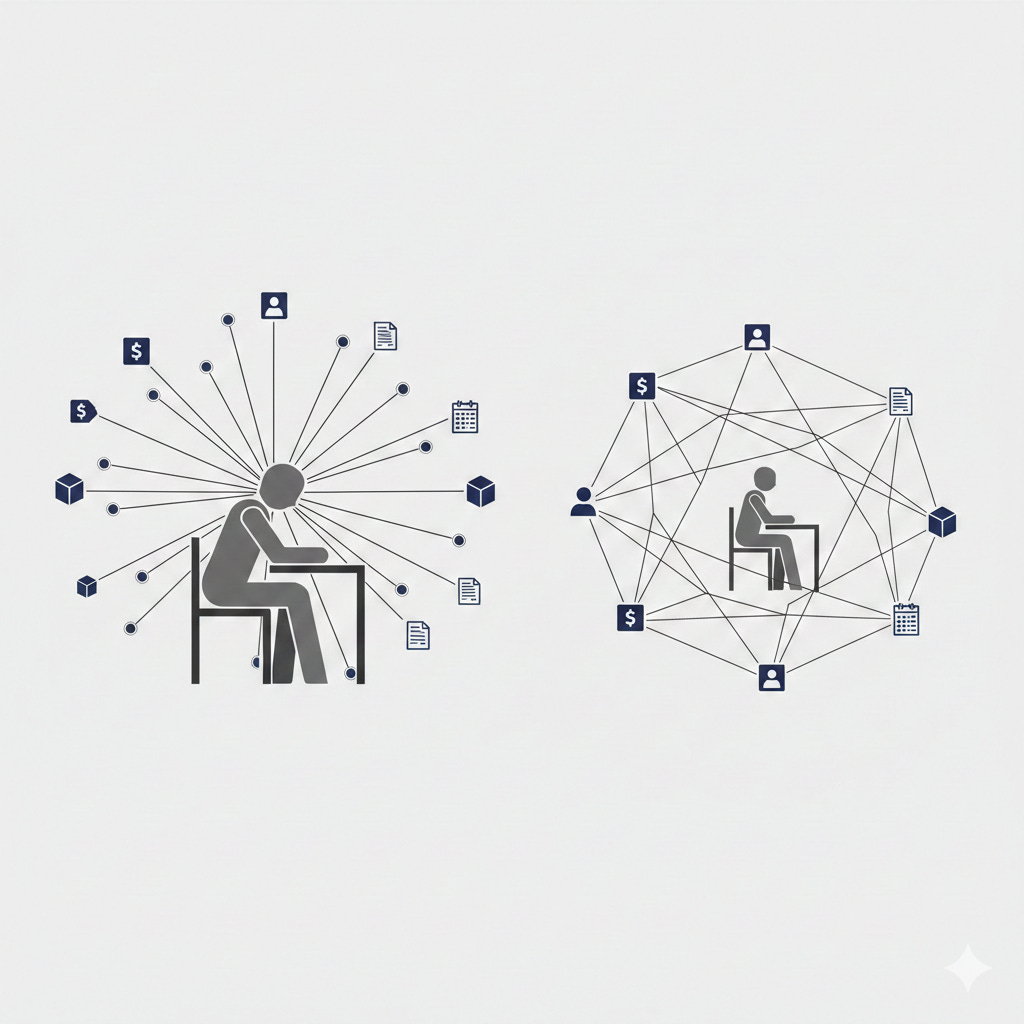
Visually, it was obvious.
He was the centre node, and everything else was a spoke.
He did not lack trust. He lacked decision architecture.
Once we rewired decision rights, pricing bands, hiring thresholds, client concession limits, two things changed.
His hours barely dropped, but his cognitive load did. Strategy time came back.
He stopped triaging. He started thinking.
Why Growth Exposes the Bottleneck
Rory Sutherland often points out that systems are constrained by their bottleneck.
Improve marketing. Upgrade talent. Inject capital.
If one node restricts flow, output caps at that node.
In operations, this is obvious. In leadership design, it is ignored.
When every meaningful decision routes through the CEO, the CEO becomes the constraining node.
Throughput equals one person’s cognitive bandwidth.
Growth multiplies decision density.
Headcount rises. Stakeholders multiply. Market volatility increases.
Cognitive bandwidth does not scale with revenue. As decision volume rises, leaders shift from strategic cognition to reactive processing.
This is not a personality issue. It is constraint math.
Cognition Under Load
Research on decision fatigue is consistent.
As decision volume rises:
People rely more on defaults. Risk aversion increases. Cognitive flexibility declines. Shortcuts replace deliberate analysis.
The more you decide, the less strategic your deciding becomes.
Now place that pressure on a single central node.
You do not get decisive leadership. You get a tired brain doing triage.
Layer in constant context switching:
Operational approvals.
Hiring trade-offs.
Client escalations.
Internal disputes.
This is not depth. It is interruption, and, over time:
Strategic foresight shrinks.
Tolerance for ambiguity drops.
Short-term bias increases.
Not because the leader lacks resilience. Because the architecture concentrates load.
Energy Depletion Is Structural
Many founders assume fatigue is personal, when it’s often architectural.
Executive decision fatigue research shows sustained decision load erodes judgement, increases rigidity, and accelerates burnout.
You cannot out-discipline this with willpower.
Energy drains fastest when:
You must decide everything.
You must remember everything.
You must arbitrate everything.
Fix the architecture and you reduce the decisions your brain must carry.
The Distributed Judgement Checklist
Assume a healthy system routes less than 30% of routine operational decisions through you.
Above roughly 40%, you are the bottleneck.
You do not need perfect numbers. You need an honest sense-check.
Decision Flow
What percentage of operational decisions required your explicit approval in the last 10 working days?
Of those, what percentage were reversible within 30 days at low cost?
How many escalations occurred because thresholds were unclear?
Architecture
Are decision rights formally defined or culturally implied?
Is escalation rule-based or personality-based?
Does authority sit closest to where information density is highest?
Cognition
In the last two weeks, how many uninterrupted 60-minute blocks did you spend on strategy?
How often were you interrupted for micro-approvals?
Do you end most days cognitively drained or strategically clear?
Dependency Signals
If you disappear for 72 hours, which specific functions stall?
Do senior operators hesitate without you?
Do you feel indispensable to routine operational flow?
If too much still routes through you, you are not leading a distributed system.
You are managing a queue.
A Simple Architecture Template
Use a basic 2x2 filter for decisions:
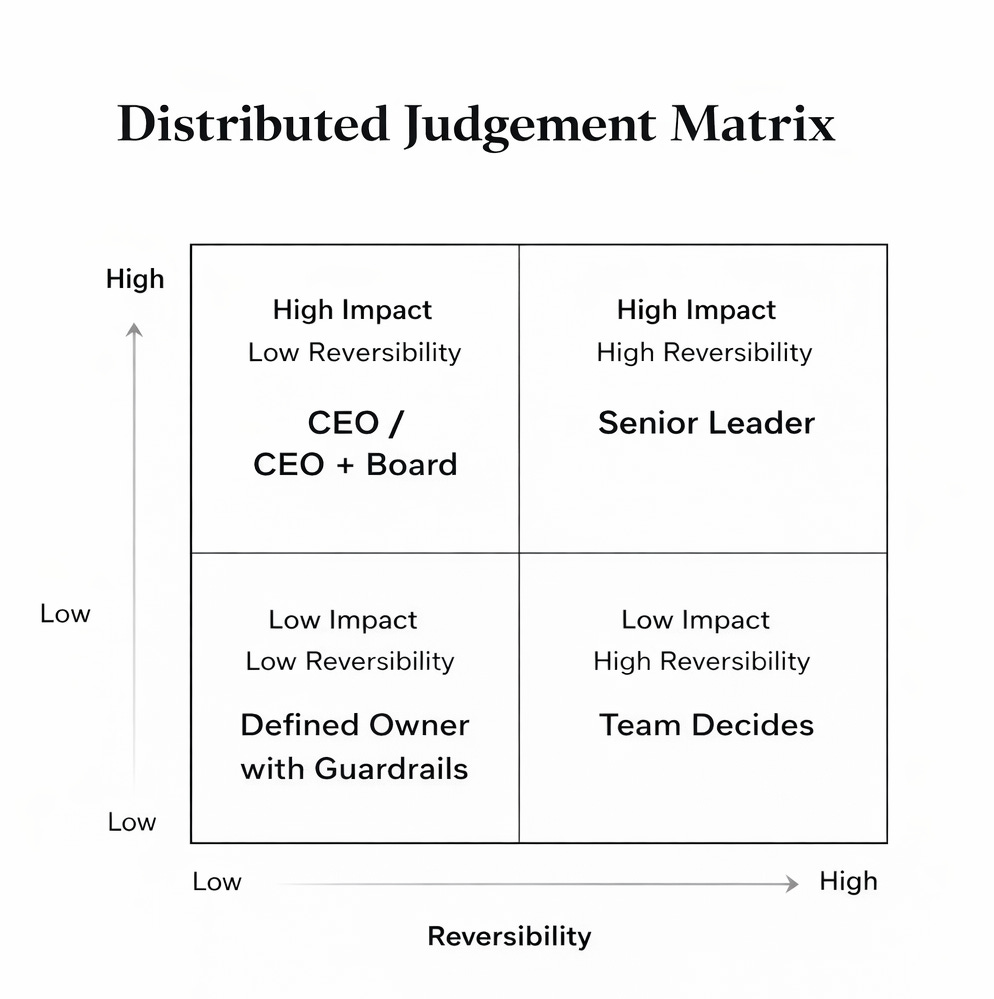
Most operational escalations live in the high-reversibility quadrants.
They never needed you.
A One-Week Architecture Sprint
Define three to five decision categories:
Pricing
People
Customer concessions
Spend
Product
Etc.
For each category, define thresholds:
What teams decide
What senior leaders decide
What only you decide
Base thresholds on risk exposure, financial amount, or irreversibility, and move authority to where information density is highest.
Replace case-by-case approvals with guardrails.
Train judgement. Not compliance.
The Inversion
Most founders ask:
“How do I make better decisions?”
The better question is:
“How do I design a system where most good decisions never need me?”
Hub-and-spoke leadership optimises for control. Distributed judgement protects speed, strategy, and energy.
Audit your last 10 working days. Calculate your percentage.
If it is above 40%, you are not overworked.
You are the constraint.